The WildClawBench paper, posted to arXiv on May 15, 2026, is not just one more coding-agent ranking. It is closer to a warning shot. If your team is serious about comparing coding agents, the object of evaluation should not be only the model and not only the in-IDE assistant feel. It should be the full working system running real tools across real long-horizon tasks. The project's GitHub README makes that framing explicit: 60 real-world long-horizon coding tasks across six task families, with an average task taking around eight minutes and more than twenty tool calls, plus the same task set re-run across OpenHands, OpenCodeInterpreter, OpenCodeAgent, and OpenClaw.
That matters for readers comparing Claude, Cursor, and GitHub Copilot. Many teams still ask “which model is strongest?” WildClawBench pushes a more useful question forward: if the same model moves across different shells, are you still buying the same product?
What actually changed
The most important part of WildClawBench is not the top row of the leaderboard. It is the benchmark design itself:
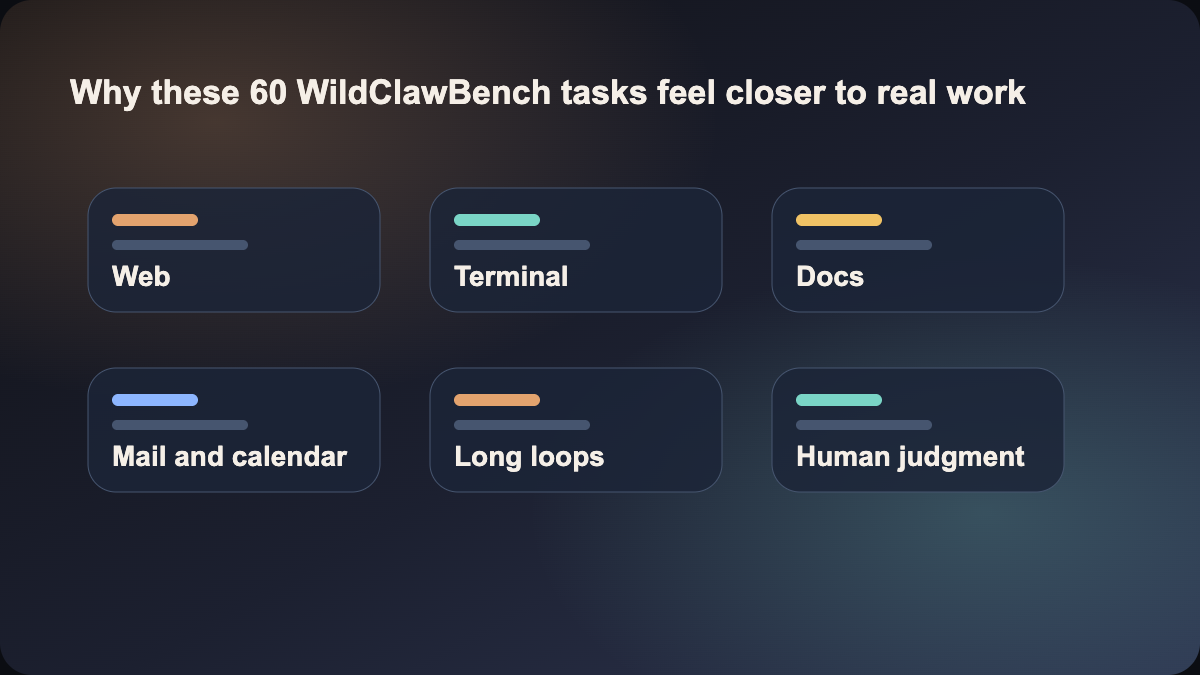
- the tasks are built around real long-horizon jobs, not only short synthetic coding prompts
- the environment spans web pages, terminal work, documents, email, calendars, and multi-step loops
- the paper and repository compare not only different models, but also how the same tasks behave under different harnesses
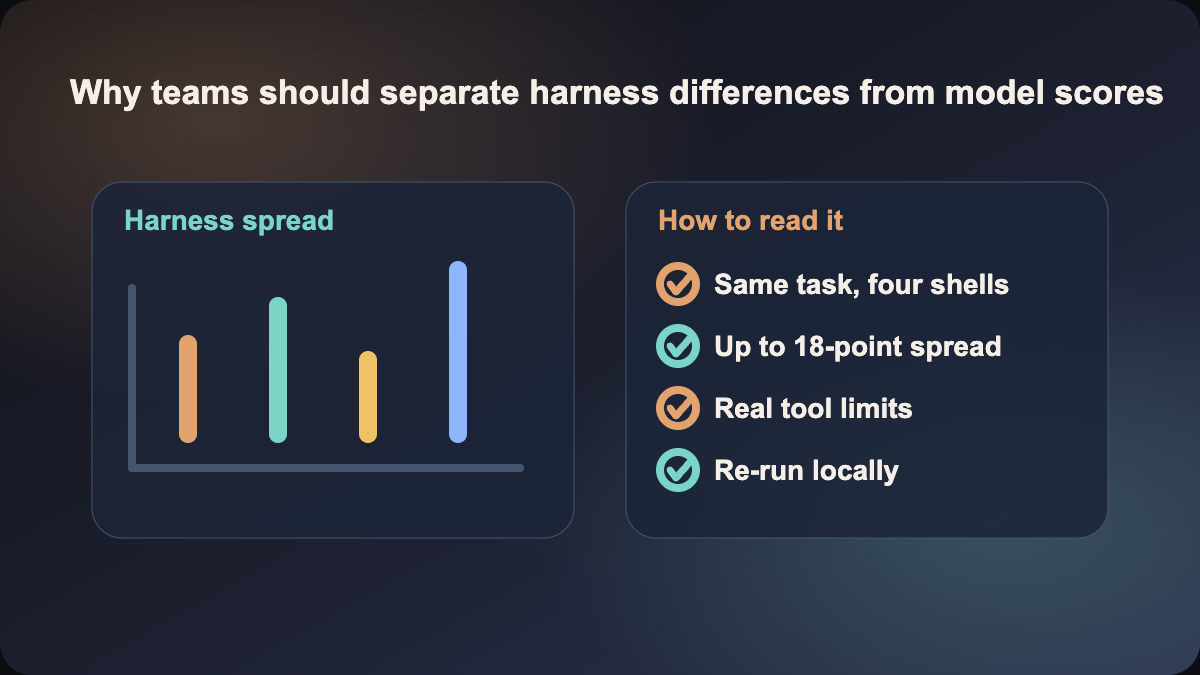
- the repository highlights a result that should matter to any buyer: the same model can separate by roughly 18 points depending on the harness
- even the current top score is only around 62.2%, which means this problem is nowhere near saturated
That makes it adjacent to our earlier Artificial Analysis coding agent benchmarks post, but not identical. Artificial Analysis is useful when you want to think about overall ranking, cost, and speed. WildClawBench is more useful when you want to understand how much the surrounding shell and tooling shape the result.
Why this matters more than a normal coding leaderboard
A lot of benchmark culture still assumes the model is the main variable and the tool shell is just packaging. Real engineering work does not behave that way. A coding agent often needs to inspect web pages, run terminal commands, read documents, reconcile partial results, recover from dead ends, and then keep going. The moment those steps live inside different runtimes, tool-selection policies, retry rules, and planning shells, performance stops being a pure model story.
WildClawBench is valuable because it refuses to hide that fact. It exposes harness differences directly, which makes it much harder to pretend the model name explains everything.
That is the practical takeaway for teams. Procurement and pilot decisions often flatten products into “same model, similar assistant.” WildClawBench argues the opposite: what you deploy is a working shell, not a naked model.
The most useful lesson for normal engineering teams
If you lead an engineering team, the thing to copy from this paper is not the screenshot of the ranking table. It is the reading method. From now on, a coding-agent benchmark should trigger at least four questions:
- Are these tasks close to the jobs we actually want to give an agent?
- Is the agent forced to work inside real tool environments rather than a simplified answer-only setup?
- How much does the score move when the same model runs under a different harness?
- Does the benchmark help explain where failures come from: reasoning, tool use, recovery, or long-loop management?
That is also why the relatedTools mapping here stays focused on claude, cursor, and github-copilot instead of turning into a random list of trending models. Site readers are usually not deciding which paper name to memorize. They are deciding whether the coding entry point they already rely on is backed by a shell they should trust more deeply.
What tasks are best to re-run internally
If you want WildClawBench to affect a real decision, do not try to replicate the entire paper first. A better move is to re-run three classes of long tasks your team already cares about:
- bug investigations that cross the web, issues, docs, and repo context
- repair loops that need terminal work, tests, and mid-task review
- refactors or migrations that require multi-file judgment over several steps
Then track success rate, time to completion, where failures stop, how often a human has to take over, and how much the outcome shifts when the same model uses a different entry point. Only then does WildClawBench stop being an interesting paper and start becoming operational evidence.
How site readers should follow this
WildClawBench is especially useful when read together with:
- Why the Artificial Analysis coding agent benchmarks matter
- Why the Open Agent Leaderboard is worth watching
- What OpenAI bringing Codex to mobile really means
The first helps frame overall ranking, cost, and speed. The second helps normalize the idea that the deployed object is a full agent system. The third shows that long-running coding agents are also changing the collaboration surface. WildClawBench ties those threads together through real tasks, real tools, and real shells.
This topic is worth publishing today because it pushes a harder truth into the open: when teams compare AI coding tools, they cannot compare only the model anymore. They need to compare the harness as part of the product.
References:
- arXiv: WildClawBench
- GitHub: InternLM/WildClawBench