Anthropic published PwC is deploying Claude to build technology, execute deals, and reinvent enterprise functions for clients on May 14, 2026. If you read it only as “another consulting partnership,” it is easy to dismiss. For readers of this site, the more useful signal is that Anthropic finally put several important pieces into one official announcement: Claude Code, Claude Cowork, a joint training system, and a new finance-focused business unit built around Claude.
That combination matters because enterprise AI competition keeps moving past “which model is strongest.” It is increasingly about which products can be deployed organizationally, which ones can enter real business functions, and which ones can be handed to large professional workforces instead of staying inside isolated pilot teams.
What actually changed
Anthropic’s official announcement gives a dense set of facts:
- the publication date is May 14, 2026
- PwC will roll out
Claude CodeandClaude Cowork, starting with U.S. teams and then expanding toward a global workforce of hundreds of thousands of professionals - the companies will establish a joint
Center of Excellenceand train and certify 30,000 PwC professionals on Claude - the collaboration focuses on three areas:
agentic technology build,AI-native deal-making, andreinvention of the enterprise function - PwC is launching a new finance business group,
Office of the CFO, built on Claude - Anthropic says Claude is already in production across sports operations, insurance underwriting, mainframe modernization, HR transformation, and cybersecurity, with delivery times reduced by up to 70%
- the post also says Claude is already available in
ChatPwC, and thatClaude Coworkwill run directly inside spreadsheet, word-processing, and presentation tools while connecting to enterprise data throughModel Context Protocol
Taken together, this is not just “PwC uses Claude.” It is Anthropic trying to push Claude from a tool surface into something that can be carried by delivery organizations, workforce training systems, and enterprise function redesign efforts.
Why this is not an ordinary enterprise case-study post
Enterprise AI announcements often have the same flaw: large logos, thin facts, and very little decision value. This one is different because it gives at least three product signals that are useful to site readers.
First, Claude Code is being framed inside enterprise delivery and production software work, not only inside an individual developer productivity story. The official post explicitly says engineering teams are using it to ship production software in weeks rather than quarters. That changes how teams should think about where Claude might sit inside engineering organizations.
Second, Claude Cowork is being described as a broader workforce interface rather than only a chat surface. Anthropic says it will run directly inside office software and connect to enterprise data through MCP. In other words, the company is pushing toward a work layer that can live inside spreadsheets, documents, presentations, and business context.
Third, Office of the CFO is an important signal. It suggests these partnerships are moving beyond loose proof-of-concept talk and toward repeatable business packaging around finance, supply chain, HR, engineering, and deal execution functions.
That gives this announcement a strong link back to Claude for Small Business. The earlier post was about connectors and ready-to-run workflows for smaller teams. This one is about organizational deployment for large enterprises and consulting delivery. Both point to the same broader direction: Claude is being pushed into real workflow surfaces rather than remaining only a general chat assistant.
The real story is organized deployment, not model improvement
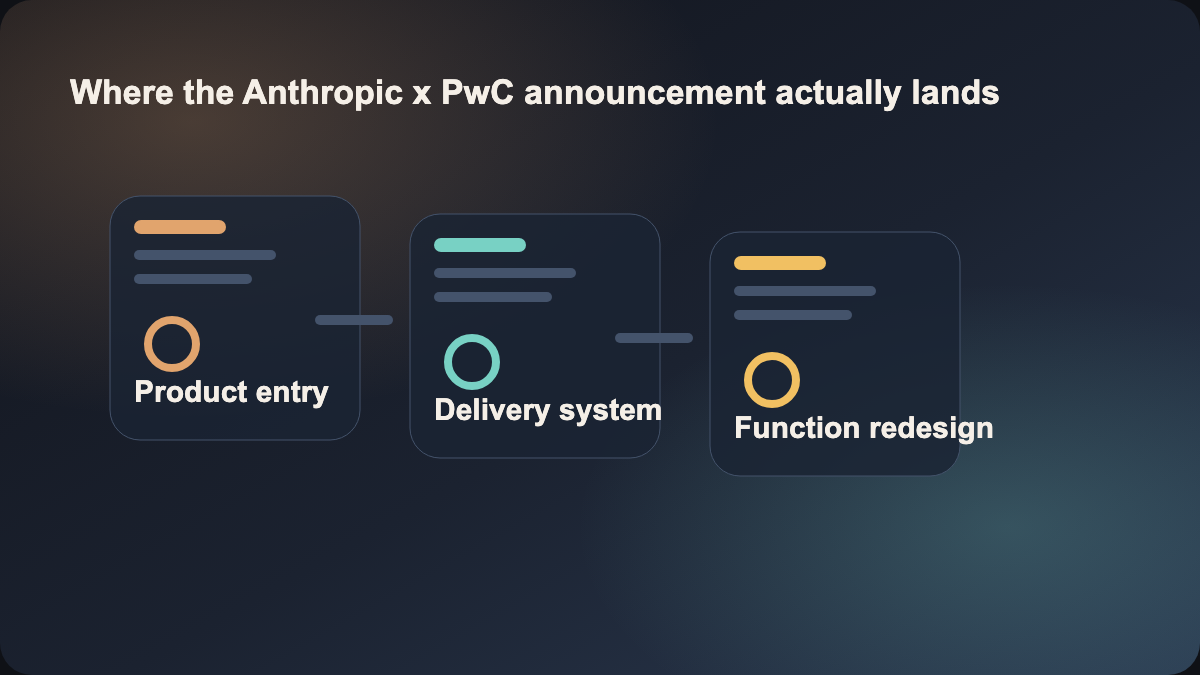
Teams often react to enterprise AI news by looking for a single headline detail: a major customer, a bigger limit, a stronger model. The more useful lens here is the organized deployment chain:
- there are clear product entry points:
Claude Code,Claude Cowork, and Claude itself - there is a clear delivery channel: PwC as an implementation and advisory organization
- there is a visible enablement system: a joint
Center of Excellenceand 30,000-person training and certification effort - there are clear function-level targets: finance, deal-making, engineering, supply chain, HR, and more
That full stack is what makes this more than a pilot story.
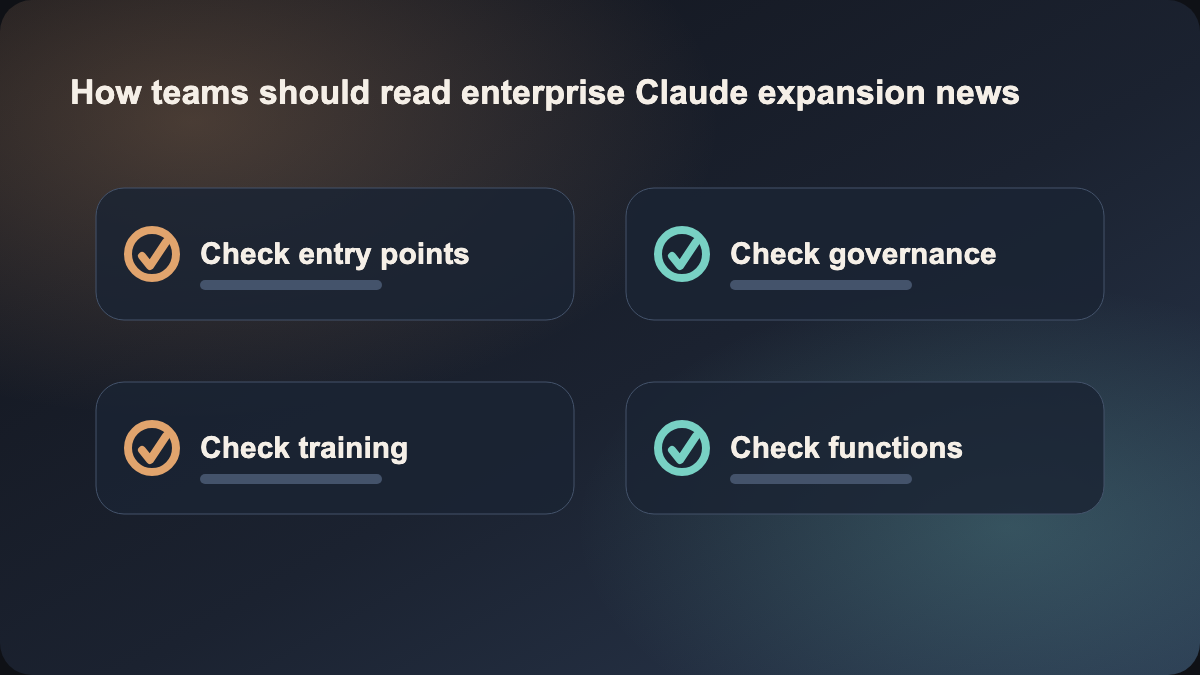
For readers of this site, this creates a practical evaluation framework for similar announcements:
- Is the news still mostly branding, or does it define product entry points and organizational boundaries?
- Is there an enablement system around training, governance, and repeatable delivery?
- Is the deployment stuck inside one team, or is it reaching actual business function redesign?
- Is the product solving “better chat,” or helping real functions keep running?
How this compares with Make and ChatGPT
The wrong takeaway would be “Claude replaces all automation tooling.” A better reading is that Anthropic is pushing toward an enterprise language-execution layer, not trying to replace every explicit workflow engine.
Make is still better suited for structured fields, trigger logic, branching, and dependable data movement. If a workflow is fundamentally about moving CRM fields, syncing systems, or writing structured outputs, Make remains the safer fit.
ChatGPT still works better as a broad general-purpose entry point for drafting, research, analysis, and individual knowledge work. What Anthropic is signaling here is not a direct copy of that general assistant layer. It is a move toward how large organizations might operate development, finance, deal, and office-software workflows through Claude.
So the rough split looks like this:
Makehandles explicit workflow orchestrationChatGPTremains a broad knowledge-work entry point- Anthropic is pushing
Claudetoward the language-heavy execution layer inside enterprise functions
That is why I attached claude, make, and chatgpt in relatedTools rather than defaulting to a generic popularity mix. This story is about choosing an organizational AI entry point, not only about model strength.
Who should pay attention now
This announcement is most useful for three groups.
The first is product, operations, and digital-transformation leaders already trying to move enterprise AI pilots forward. They should pay less attention to the logo pairing itself and more to whether the chain of training, delivery, office entry points, and function-level targets is becoming concrete.
The second is teams already using Claude or ChatGPT for writing, meetings, summaries, and analysis. This post is a good prompt to ask whether they are still living inside chat windows or beginning to design repeatable, reviewable workflows.
The third is engineering and automation teams. The way Anthropic describes Claude Code and Claude Cowork suggests that the future enterprise AI layer may not live in one separate app. It may sit directly inside coding surfaces, spreadsheets, documents, and business operations.
Why I am publishing only this one today
I did check a second candidate today: Google’s May 12, 2026 Googlebook and Magic Pointer launch. It is clearly new and product-rich, but right now it leans more toward hardware and consumer-entry storytelling than toward the site’s core lens of tool selection, workflow building, model understanding, and enterprise rollout judgment. Compared with that, the Anthropic x PwC announcement offers stronger enterprise routing value and cleaner internal-link opportunities, so it is better to publish one strong article than force a second weaker one.
Sources:
- Anthropic: PwC is deploying Claude to build technology, execute deals, and reinvent enterprise functions for clients
- PwC: Anthropic alliance page