OpenAI announced the OpenAI Deployment Company on May 11, 2026. The official announcement says the new company is meant to help businesses build around intelligence, and that its engineers will connect OpenAI models to customers’ data, tools, controls, and core business processes. OpenAI also said it agreed to acquire Tomoro, an applied AI consulting and engineering firm.
The important part is not only that OpenAI is moving deeper into services. The bigger signal is that enterprise AI is moving from model trials into deployment work: workflow design, quality checks, adoption, measurement, and ongoing operations. For readers choosing AI tools, this is a useful reminder that the next bottleneck is not always model intelligence. It is whether the model can become part of a real business process.
Why This Is Not Just Another Product Launch
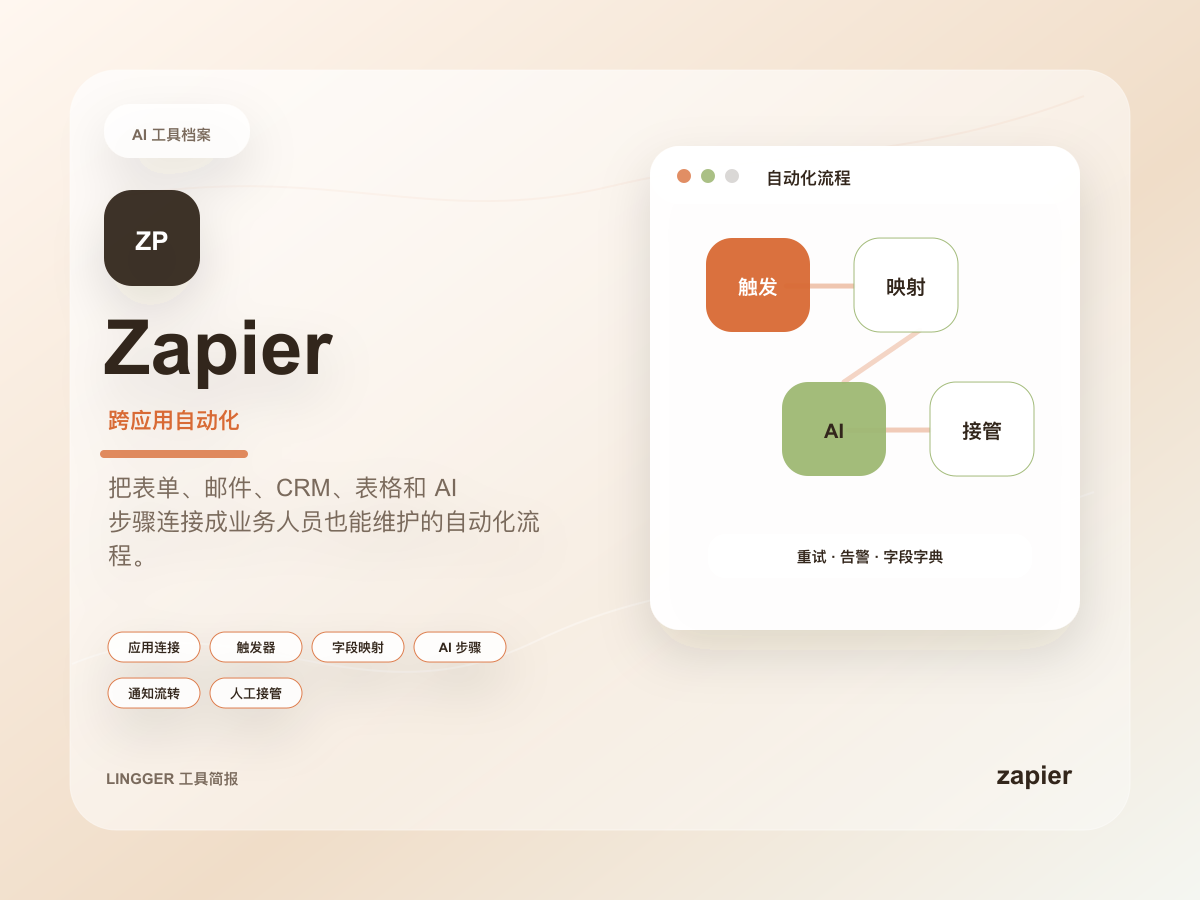
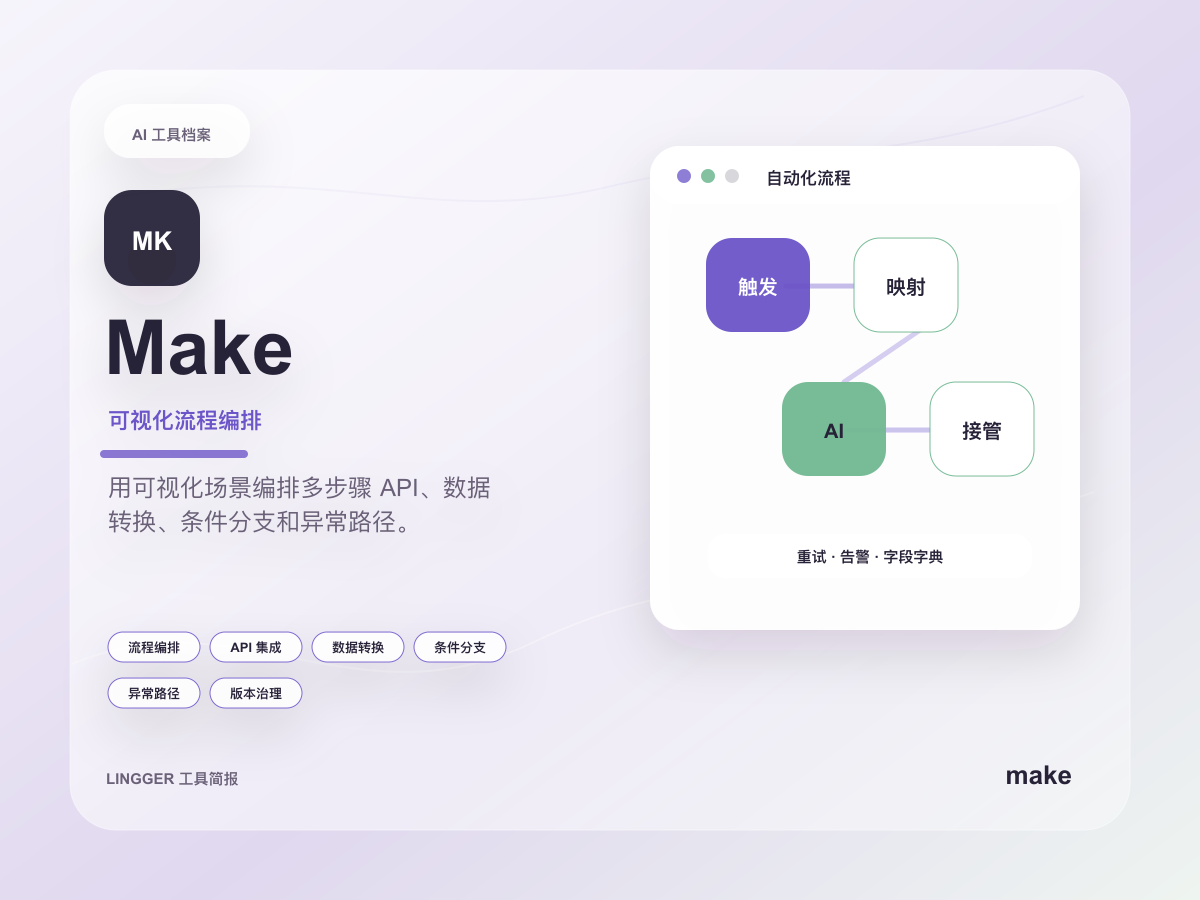
Many organizations have already tried AI in small pockets. Employees use ChatGPT to write emails, summarize meetings, and draft code. Teams use Zapier or Make to connect simple automations. But critical workflows are harder. Data lives in different systems. Access rules are unclear. Output quality varies. Employees do not always adopt the new process. Leaders do not always see measurable value.
DeployCo is aimed at that gap. Model capability is no longer the only constraint. Companies need help putting AI inside specific roles, systems, controls, and metrics. OpenAI’s language about connecting models to data, tools, controls, and core business processes is more concrete than “give the enterprise a better chatbot.”
What Smaller Teams Can Learn
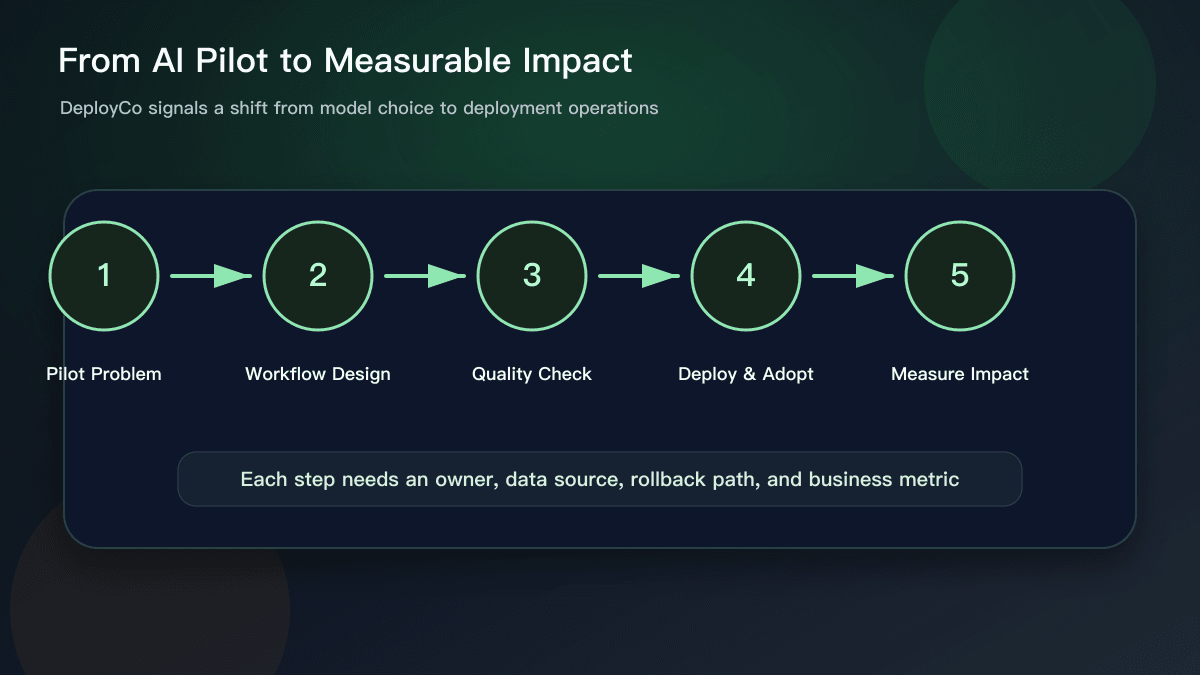
Most small teams will not hire DeployCo, but they can copy the deployment sequence. Do not start by buying more tools. Start by choosing one frequent, low-risk, measurable workflow. Good candidates include lead intake, support summaries, content briefs, sales follow-up notes, operations reports, and bug triage. Define the input, output, owner, review point, and success metric before choosing the tool stack.
Many AI automation efforts fail because teams skip the workflow. “Automatically reply to customers” sounds powerful, but it touches brand voice, pricing promises, sensitive information, and emotional context. A safer first version is to let AI draft the summary and suggested reply while a person decides what to send. Review the failures every week and then decide what can be automated further.
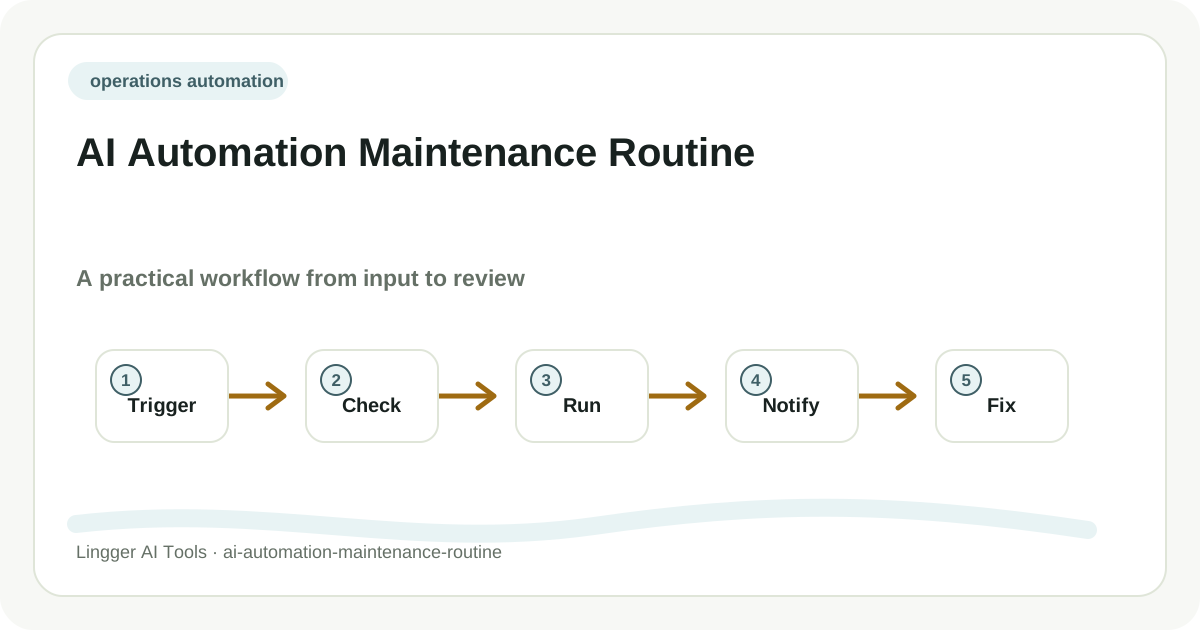
If you are already building AI automation for small teams, this announcement turns into a checklist. Does the workflow have an owner? Does it preserve the original input? Does it alert someone when it fails? Can you measure saved time, faster response, or better conversion quality? If not, it is still a demo rather than a business system.
The Roles Enterprise AI Needs
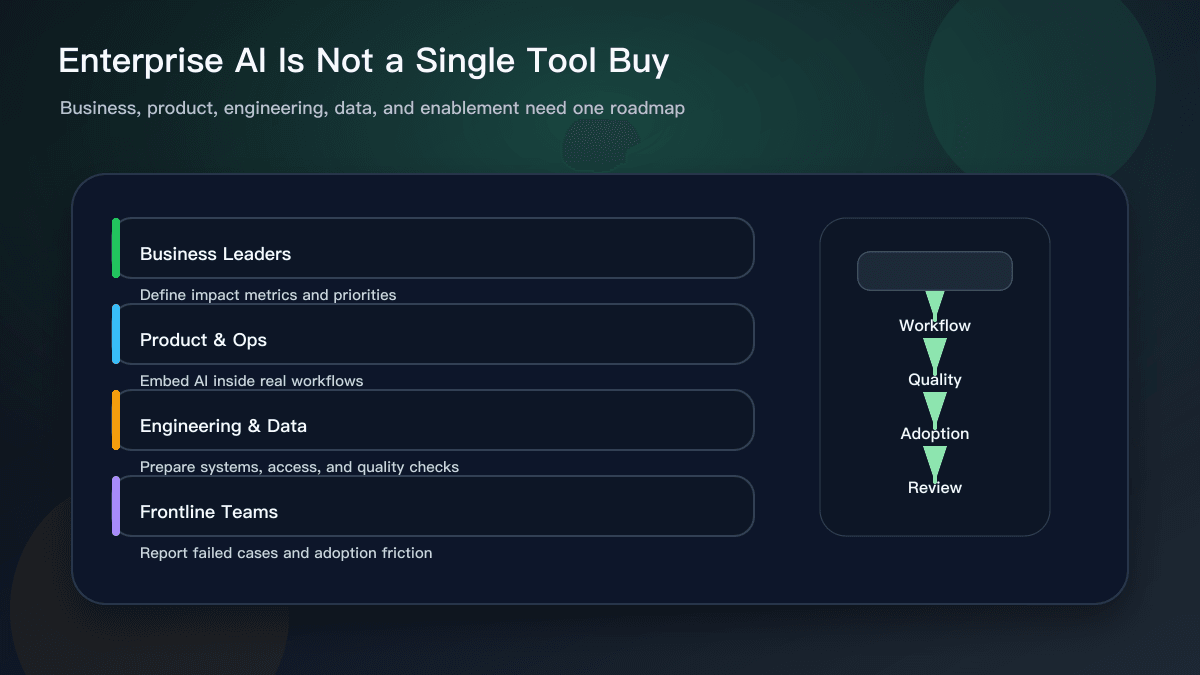
Enterprise AI is not a single tool purchase. Business leaders define impact metrics. Product and operations teams redesign the workflow. Engineering and data teams connect systems, access, and quality checks. Frontline teams report failed cases and adoption friction. Without those roles, AI stays in an impressive demo lane.
That is also why ChatGPT is not the whole stack. ChatGPT is strong for reasoning, drafting, and transformation. Zapier is useful for simple triggers and app connections. Make is better when the workflow needs branches, field transformations, and multi-step orchestration. Real deployment usually combines a model, automation platform, internal data, and human review.
Turning This Hotspot Into Action
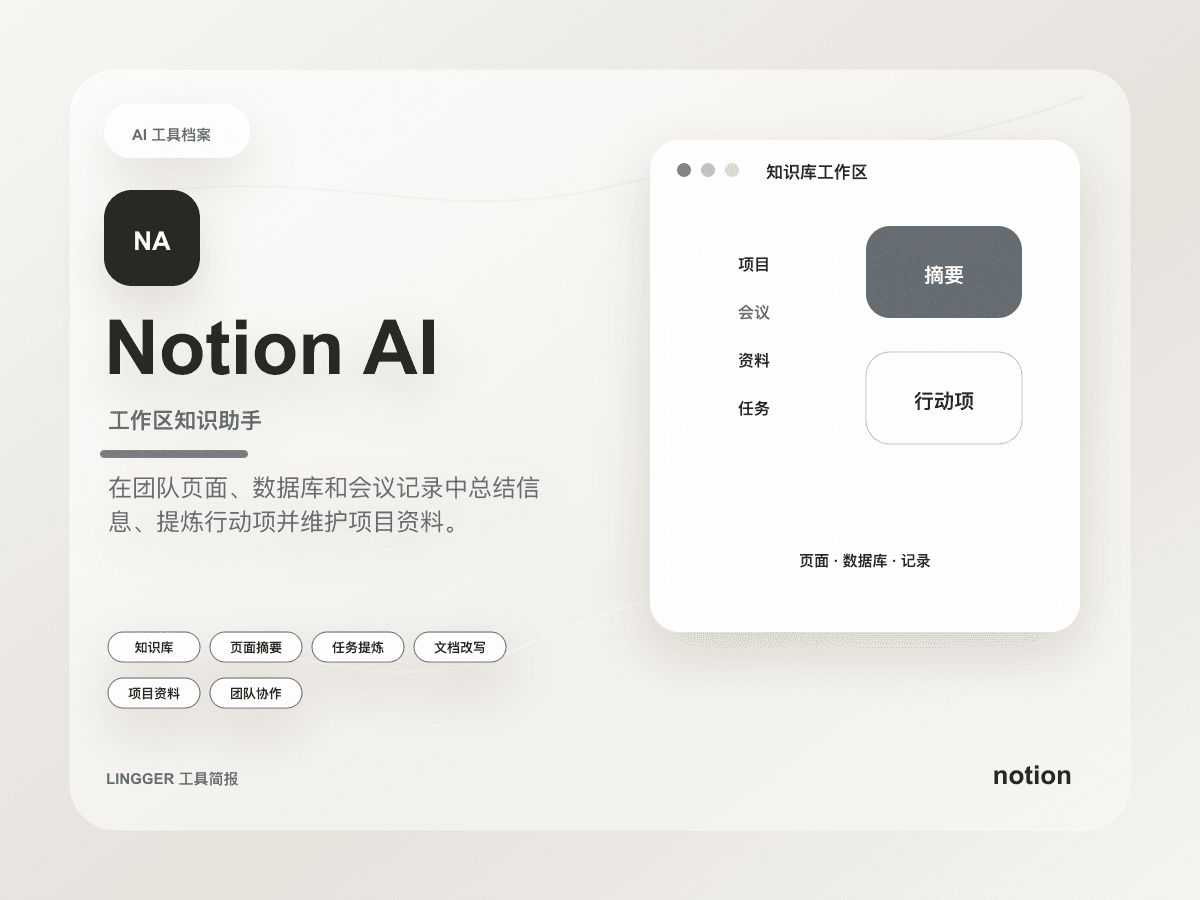
A practical follow-up is a 30-day experiment. Pick one workflow, such as website lead intake. During week one, measure the current process: where leads arrive, who handles them, how long replies take, and how many are missed. During week two, use AI only for summary and classification. During week three, add Zapier or Make so new leads enter a table or Notion workspace and notify the owner. During week four, review the evidence: faster response, less manual sorting, fewer missed leads, and any AI mistakes.
That experiment is more useful than a vague “AI transformation” plan because it creates evidence. The direction behind DeployCo is to get AI into production workflows and measurable business impact. Smaller teams can do the same thing at a smaller scale: one process, one table, one review point, one metric.
Why This Was Worth Covering
This was a strong daily-hotspot topic because it came from OpenAI on May 11, 2026 and connects directly to enterprise AI, automation workflows, and tool selection. Compared with lower-value announcements, it gives readers a practical decision frame: AI automation is not about stacking tools. It is about redesigning a workflow around evidence and adoption.
Sources:
- OpenAI: OpenAI launches the OpenAI Deployment Company to help businesses build around intelligence https://openai.com/index/openai-launches-the-deployment-company/
- Axios: OpenAI launches AI consulting arm valued at $14 billion https://www.axios.com/2026/05/11/openai-deployco-private-equity